

Coastal Outdoor Living: How to Design an Exterior Space That Truly Lasts
Why teak furniture thrives in coastal climates — and how California and Hamptons homeowners design outdoor spaces built to last.
Living by the coast has a distinct appeal. The light, the rhythm, the connection to the landscape. But it also comes with a less visible reality: outdoor environments are far more demanding than they seem.
Salt air, constant humidity, and prolonged sun exposure don’t just affect comfort; they directly impact how materials perform over time. In this context, designing an outdoor space is not only an aesthetic decision. It’s a choice that determines how long everything you select will actually last.
For homeowners in coastal environments, this becomes even more critical: the goal is not just to create a beautiful space, but one that holds up over time without constant replacement.
In this guide, we explore how outdoor spaces are designed in two iconic coastal settings, California and the Hamptons, and what they share when it comes to materials, style, and long-term thinking.
The coastal challenge: how salt air and sun affect outdoor furniture
Designing for coastal environments begins with understanding wear, not as a possibility, but as a constant.
Salt air accelerates oxidation, particularly in metals that are not engineered for marine conditions. Even treated pieces can begin to show signs of corrosion earlier than expected, especially in joints, hardware, and less visible components.
UV exposure adds another layer of stress. Plastics, resins, and synthetic materials often begin to degrade within just a few seasons, losing not only their color but also their structural integrity. What initially appears low-maintenance can quickly become short-lived.
Humidity presents a different challenge, especially for lower-density woods. Uneven moisture absorption leads to internal movement, which can result in cracking, warping, and long-term instability.
This is why material selection in coastal settings is not just a design choice; it’s a performance decision. In salt air, hardware is the first thing to fail; see why we use 316L.
.jpg)
In this context, material selection becomes less about appearance and more about performance. Teak, with its natural oils and dense grain, resists moisture and salt without requiring constant treatment. 316L stainless steel, due to its composition, offers superior resistance to corrosion even in coastal environments. Learn more about teak wood furniture here.
Textiles are another critical, and often underestimated, component. Cushions are continuously exposed to sun, humidity, and salt air, making material choice essential.
High-performance fabrics such as Sunbrella are not just resistant; they retain their texture and color over time. Equally important is the ability to replace covers or cushions as needed, extending the life of the entire setup without replacing the structure.
At Westminster Teak, replacement cushions and fabric options are available, making it possible to maintain and refresh outdoor spaces over time without replacing the furniture itself.
The California aesthetic: relaxed outdoor luxury
Along the California coast, outdoor design is built on a clear idea: the space doesn’t end at the door.
Indoor and outdoor areas flow into one another, creating a continuous environment where transitions feel almost invisible. This reflects a way of living where outdoor spaces are used as naturally as interiors.
.jpg)
The aesthetic doesn’t aim to stand out; it aims to belong. Neutral palettes, natural materials, and a restrained visual language create a sense of calm and cohesion. Every element is designed to coexist with the landscape, not compete with it.
But this simplicity is intentional. Behind it lies a precise balance of proportions, textures, and materials that ensures the space works over time.
This approach reflects the way outdoor living is understood along the California coast, where Westminster Teak has an established presence through its showroom and long-standing design expertise.
Furniture plays a quiet but essential role. Clean lines and balanced volumes help define the space without making it feel rigid.
Collections like Kafelonia, Maya, and Horizon reflect this approach, contemporary in design, yet subtle enough to integrate seamlessly into the environment.
The Hamptons approach: classic elegance, built to last
In the Hamptons, the approach shifts, but the standard remains just as high.
Outdoor spaces are not secondary; they are integral to the home’s identity. Every decision is made with permanence in mind, both aesthetically and structurally.
.jpg)
Unlike in California, furniture here is not meant to blend into the background. It has presence. It defines areas, structures the layout, and contributes to a clear sense of place.
The aesthetic leans more traditional, with references to classic design, symmetry, and detail. But this elegance is not superficial; it is supported by materials and construction that ensure long-term durability.
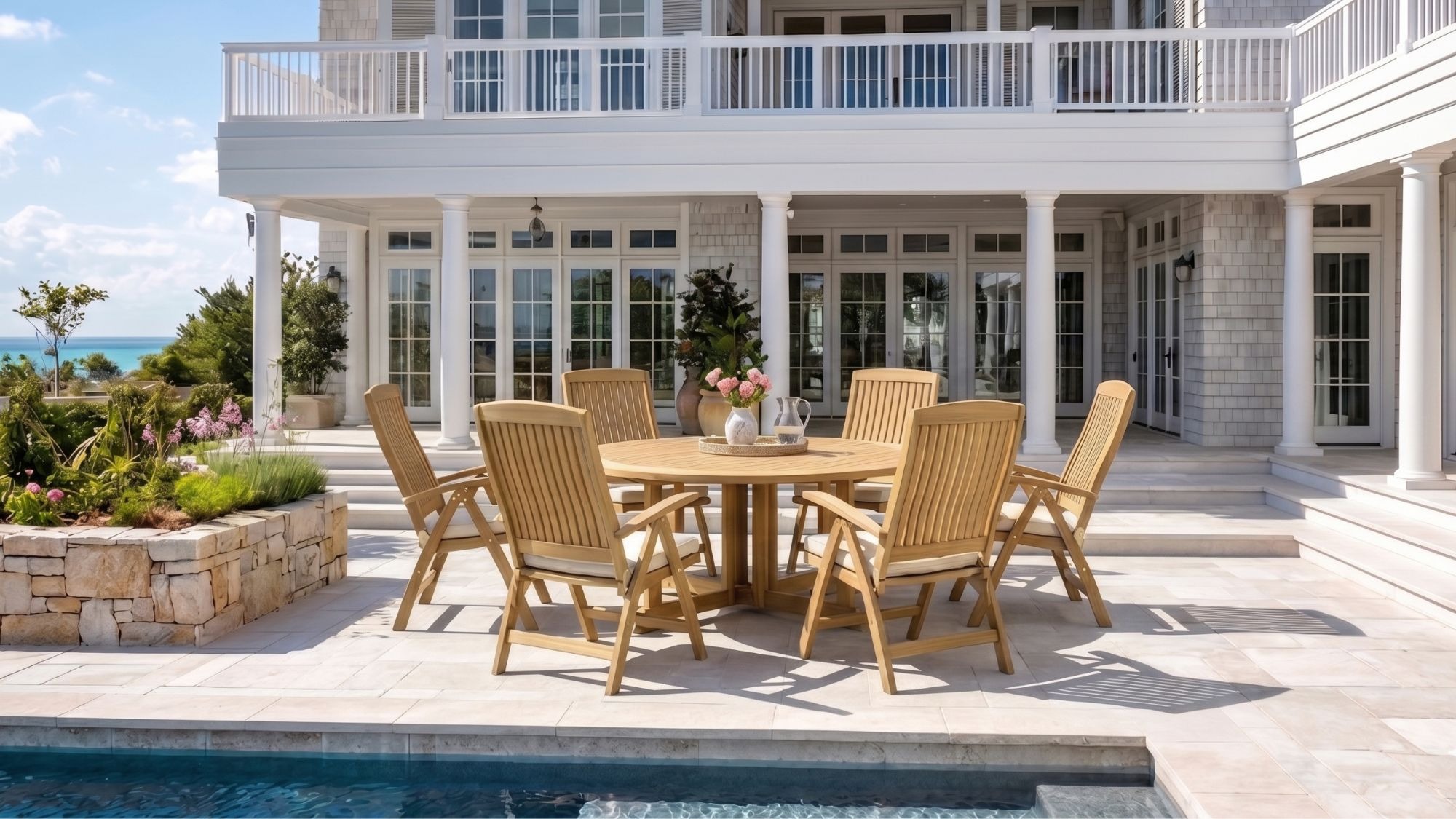
In this context, outdoor furniture is not seasonal. It becomes part of the property itself.
Collections such as Veranda and Laguna align naturally with this perspective, combining structural integrity with a timeless visual presence.
What both styles have in common
Despite their differences, California and the Hamptons share a fundamental principle: they design with time in mind.
Materials are not chosen solely for how they look today, but for how they evolve. Aging is not avoided; it is anticipated.
In teak, for example, the development of a natural patina is not seen as deterioration, but as transformation. It reflects authenticity and continuity rather than wear.
This perspective shifts the logic of purchasing. What might be replaced in other contexts is, here, designed to remain.
Designing your coastal space: where to begin
Designing a coastal outdoor space requires balancing aesthetics with performance.
Scale is one of the first considerations. In larger spaces, undersized pieces can feel disconnected and lack presence. In more compact areas, oversized furniture can overwhelm and restrict movement.
Textiles, once again, play a key role, not only in durability, but in adaptability. The ability to refresh cushions or covers allows the space to evolve without replacing its core elements.
Maintenance, while minimal with materials like teak, is still part of the equation. Basic cleaning and attention to exposed details help extend the lifespan of the furniture, even in demanding conditions. To learn more about taking care of teak outdoor furniture, visit our blog post here.
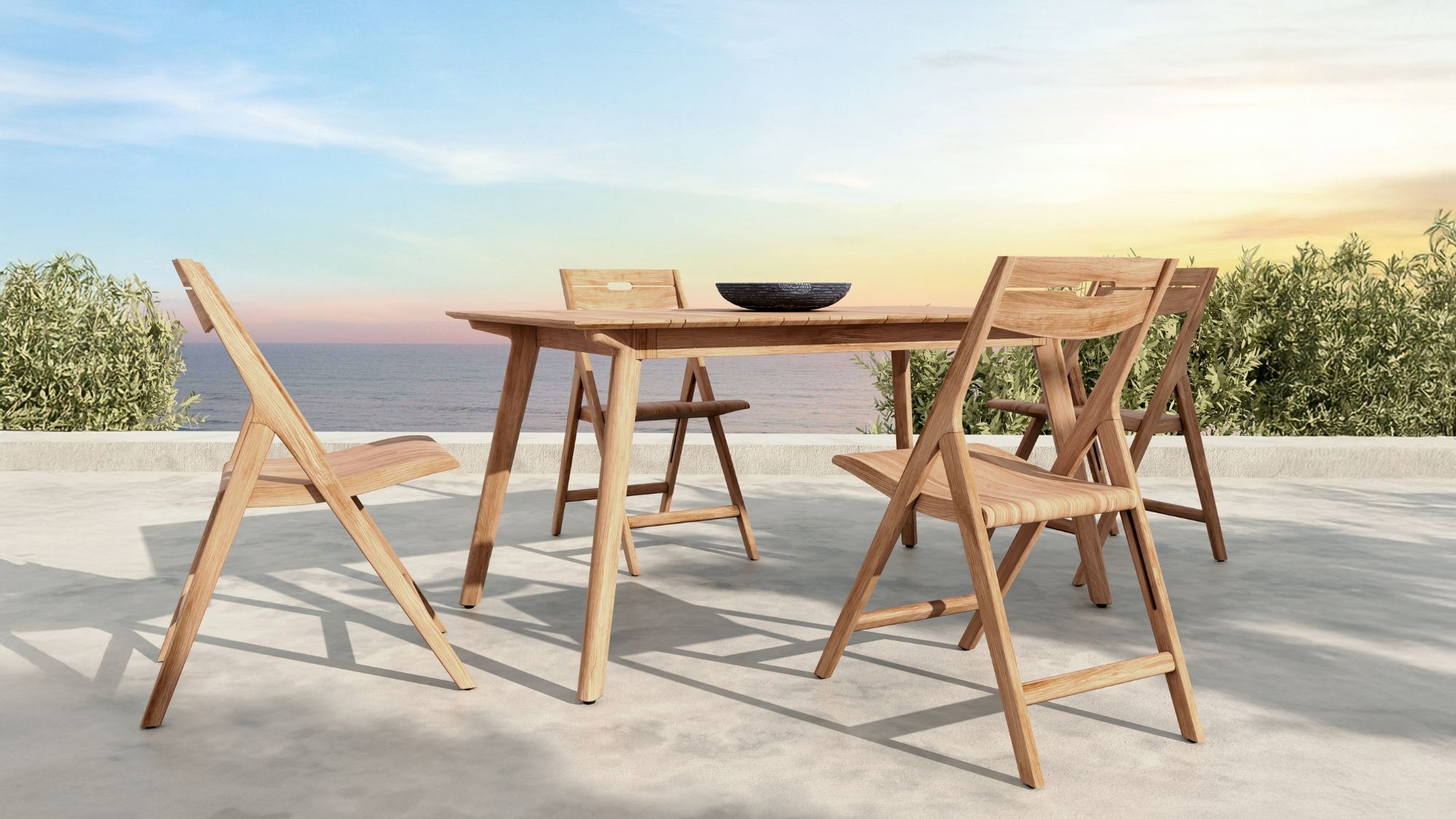
Ultimately, the most important decision is choosing materials that work with time, rather than against it.
Designing an outdoor space by the coast is not only about style. It’s about understanding how the environment shapes every material, and choosing accordingly.
Because when design and materiality are aligned, the result doesn’t just look right, it endures.
And once that becomes clear, it’s easier to recognize which materials, and which pieces, are truly designed to last in coastal environments.
If you want help from our design specialists, please reach out to us here or by calling +1 888-592-8325.
Learn how hotels design their spaces in our blog post: How Hotels Choose Outdoor Furniture.
Related Posts


Stay in Touch
Oops! Something went wrong while submitting the form


